
Only Two Classes Matter
Forget left and right. Forget rich and poor. The oldest and most honest division in human society has always been predator and prey — and the system depends on us never seeing it that way.

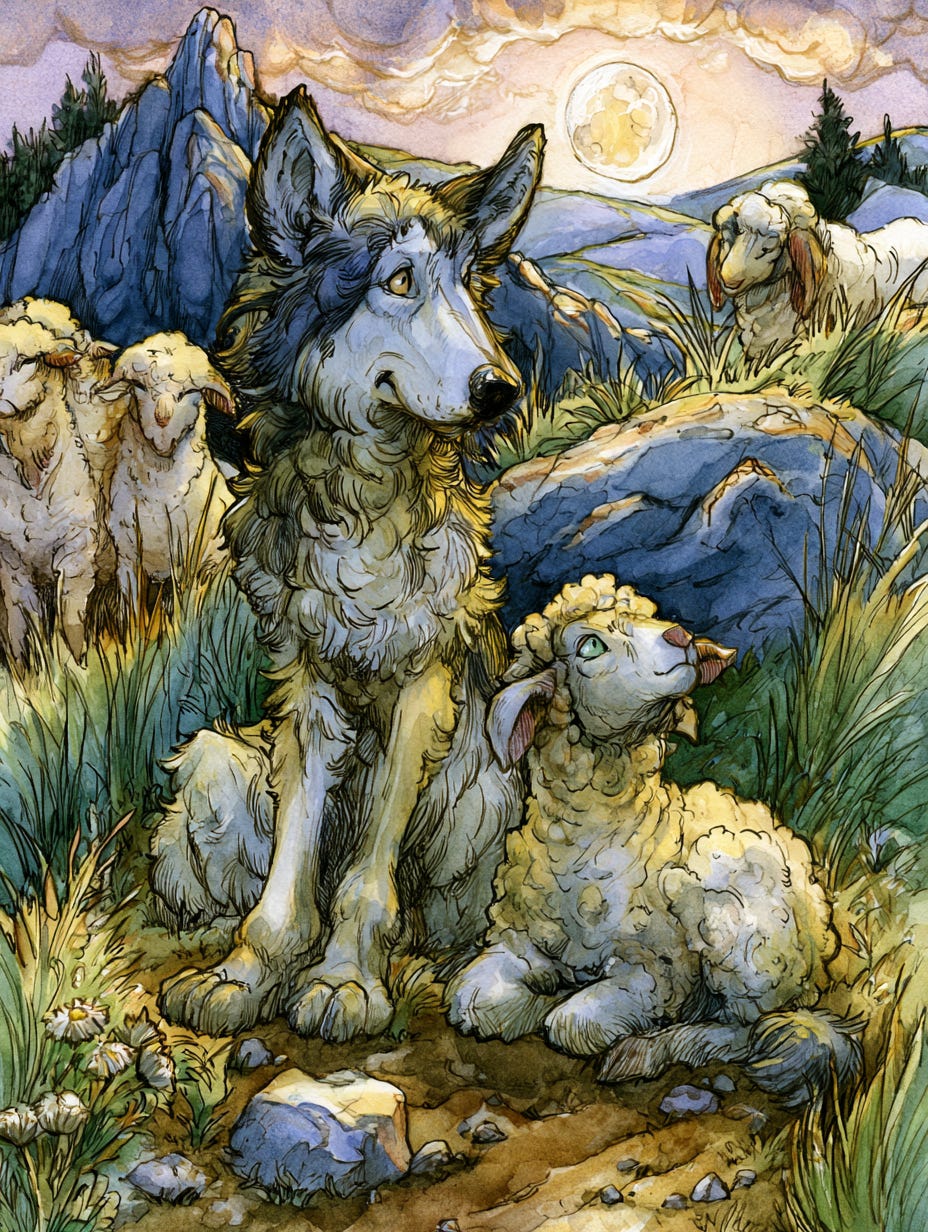
A political and psychological investigation
There is a reason the class war framing never quite lands. It arrives correctly dressed, with the right vocabulary, waving the right flags. And yet it keeps failing to explain what you actually see when you look around. Your neighbour, working three jobs, still somehow finds a way to crush the person beneath him on the ladder. The middle manager who knows the company is gutting its workers and enforces the policy with enthusiasm. The family that finally gets a little land and immediately finds a way to charge rent. The framework that says rich versus poor or capital versus labour keeps bumping into this uncomfortable fact: cruelty replicates at every level, all the way down to the street.
A more useful lens may be older and more biological. Predator and prey. The ancient primal mechanism.
The Architecture of Extraction
At the very apex of this structure sits a small group defined not by wealth alone but by their intentions and design. They are not simply the beneficiaries of a system, they are partly its architects. Their distinguishing characteristic is that they understand, explicitly and without illusion, the predator-prey dynamic that organizes everything in their universe. They do not call it that, of course. But they act accordingly.
Sociologist C. Wright Mills mapped the terrain of this apex class in 1956, in a book that remains as accurate as this mornings news. He called them the power elite, not a conspiracy, not a secret society, but an interlocking set of circles sharing decisions with national and global consequences.
“The truth about the nature and the power of the elite is not some secret which men of affairs know but will not tell… No matter how great their actual power, they tend to be less acutely aware of it than of the resistance of others to its use.”
— C. Wright Mills, The Power Elite, 1956
That last sentence is the key. The most sophisticated predators do not think of themselves as predators. They have absorbed the logic of extraction so completely that it presents itself to them as simply the natural order: as excellence, as merit, as the way things must be. Mills noted that people with advantages come readily to see themselves as naturally worthy of those advantages, and to experience their privileges as organic extensions of their own superior selves. The cage is invisible because it has been furnished so well.
The Wolf, the Sheepdog and the Sheep
Do you remember watching Bugs Bunny?
I would watch it every Saturday with my father. There was one with a wolf and a sheepdog, both showing up to the same field, punching in, playing their roles. I thought it was funny. The costumes, the chase, and getting-caught.
But my father loved that cartoon. Really loved it. And even as a child I understood there was more to a story than first appearances.
What stayed with me was this: neither one of them was really looking at the sheep. They were looking at each other. The whole game was between them. The wolf needed the sheep to have something to steal. The sheepdog needed the sheep to have something to protect. But the sheep themselves, what they needed, what they felt, what was happening to them, that was always part of the game.
The sheep were the mechanism.
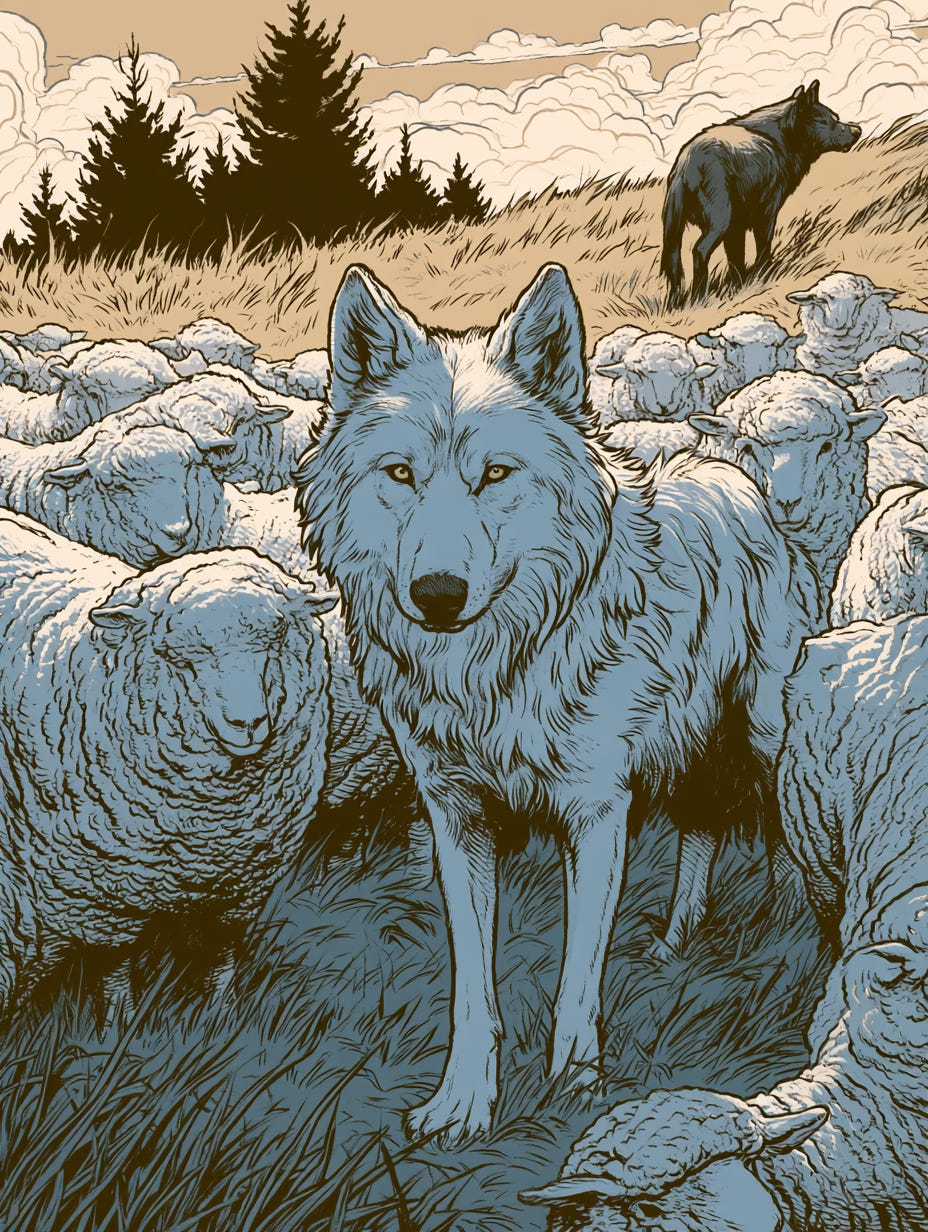
The Complicit and the Knowing
Below the architects of the power dynamic sits a second tier, the wealthy and powerful who did not build the system but have been shown enough of its workings to understand the real game. These are not ignorant people. They have been informed. And their silence is not passive. It is purchased, maintained, and functionally active.
This is a crucial moral and analytical distinction that conventional class analysis tends to miss. It is not enough to say that someone benefits from an unjust system without awareness. The person who knows, and does not speak, is performing a specific act. Their silence is a form of participation. It sends a resource, the resource of continued concealment, directly upward, every single day.
Herman and Chomsky, in their landmark study of how mass media functions, identified this mechanism with precision. What keeps the system running, they found, is not orders from the top but something far more durable: the internalization of acceptable limits by people at every level of the institutional chain.
“Most biased choices in the media arise from the preselection of right-thinking people, internalized preconceptions, and the adaptation of personnel to the constraints of ownership, organization, market, and political power.”
— Edward Herman & Noam Chomsky, Manufacturing Consent, 1988
This is not limited to media. Replace “media” with any institution, finance, law, medicine, education, government, and the sentence holds. The system does not need enforcers if it can produce people who enforce themselves.
The Trickle-Down of Predation Itself
Here is where the theory touches your street, your block, your neighbours. Because by the time the logic reaches the bottom, nobody is orchestrating anything. People are simply responding to conditions that were engineered so far above them that the source is invisible. And those conditions reward predatory behaviour at every level, right down to the micro.
The landlord who charges crushing rent to the family beneath him is not a member of any elite circle. He is replicating a pattern he has absorbed from the pattern above him. The boss who enforces pointless humiliations on a team he knows is underpaid is performing the same imitation further down the chain. The neighbour who finds some small way to extract from another neighbour. It is what happens when a predatory logic becomes so thoroughly baked into the structure of a society that survival itself begins to require predatory strategies.
Pierre Bourdieu, the French sociologist who spent a lifetime studying how power reproduces itself through culture rather than force, called this mechanism symbolic violence. It is when dominant values are internalized by the dominated until they experience their own subordination as the natural, inevitable, perhaps even deserved. He described it as violence wielded with the tacit complicity of both those who exercise it and those who endure it, insofar as both remain unconscious of what is actually happening.
The prey class polices itself. That is the elegance of the system. No visible chain is needed when the chain has been created inside the mind.
The Manufacture of the Enemy Within
Now we arrive at the most sophisticated instrument in this architecture, the one that requires no force, no overt deception, no visible authority. If you can convince the prey class that they themselves are the problem, you have achieved something extraordinary: a self-defeating resistance. A population that turns its energy inward, that spends its force on guilt and accusation, that fractures itself along manufactured fault lines — that population is not going anywhere.
The Brazilian philosopher and educator Paulo Freire spent his life among the most economically devastated communities in the world, and what he found there was not ignorance. It was something more tragic: a population that had absorbed the image of the oppressor so completely that they had begun to see themselves through the oppressor’s eyes.
“The oppressed, having internalized the image of the oppressor and adopted his guidelines, are fearful of freedom. Freedom would require them to eject this image and replace it with autonomy and responsibility.”
— Paulo Freire, Pedagogy of the Oppressed, 1968
Freire went further. He observed that in the early stages of any movement toward liberation, the oppressed, rather than seeking a new and just order, tend to seek only to occupy the oppressor’s position. Their vision of freedom is not freedom. It is becoming the predator. This is not a moral indictment of the oppressed. It is a precise description of what a predatory system does to human psychology over generations.
But Freire was writing about populations who at least recognized, however vaguely, that something was being done to them. The more refined and modern version of the trap is this: you do not even need to convince someone they are oppressed and helpless. You just need to convince them they are the oppressor. Then they will do the rest themselves.

Guilt as Paralysis, Accusation as Weapon
A person spending their psychic energy processing shame and culpability is not a person looking upward at where the extraction is actually happening. Guilt is not an action state. Shame is not a platform for organizing. They are freeze states: physiologically, neurologically, and socially. The research on this is not ambiguous.
Psychologists Claude Steele and Joshua Aronson demonstrated through decades of study that when people anticipate being judged or categorized in a negative way, what they called stereotype threat, they tend to self-censor, withdraw, and underperform. The anticipation of accusation produces many of the same effects as the accusation itself. People shrink. They manage impressions. They stop taking risks. And a population that is perpetually managing the threat of being labeled the enemy is a population that cannot effectively organize against anything.
The genius of this instrument, and it deserves to be called that, however dark its genius, is that it does not even require real complicity. The appearance of complicity serves equally well. If you can frame someone as the enemy: through selective association, through decontextualized evidence, through manufactured or amplified narrative, you achieve two things at once. You discredit them before they speak. And you send a signal to everyone watching about the cost of stepping out of line.
The prey class then does exactly what prey classes under stress tend to do: it turns on itself. It argues about who is most implicated, who is least pure, who carries the most guilt. Meanwhile the actual architecture of extraction proceeds undisturbed, largely invisible, occasionally even celebrated.
The Dilution of the Field
There is one more instrument worth naming, because it may be the most ambient and therefore the most effective. It is the deliberate multiplication of explanatory frameworks. Not the suppression of alternative ideas, that would be too visible, too crude. Instead: the proliferation of them.
When a hundred competing narratives exist about what is happening: class war, race war, culture war, generational war, gender war, left versus right, urban versus rural, vaccinated versus unvaccinated, the field of attention becomes diluted to the point of uselessness. Everyone is simultaneously right about something and wrong about everything. No single account gains enough traction to become actionable. People who might otherwise recognize a common condition instead become advocates for incompatible frameworks, each certain the others are missing the point.
C. Wright Mills called this the problem of the mass society a condition in which the bottom is fragmented and passive while the top grows increasingly unified and coordinated. He wrote that the top of modern society is increasingly unified and often deliberately coordinated, while the middle drifts in a stalemated balance of forces, and the bottom, the mass, becomes fragmented and, as a passive fact, increasingly powerless.
A fragmented prey class is not a class at all. It is a collection of individuals, each navigating conditions alone, each believing their particular struggle is the one that is relevant. Which is exactly the condition that predation requires in order to continue uninterrupted.
What the Street Actually Shows You
None of this requires a master plan. That is the important thing to hold. The most durable systems of extraction are not run by conspiracies, they are run by incentives. Structures that reward predatory behaviour at the top produce cultures of predatory behaviour all the way down. No memo is required. The logic propagates because it works, at each level, for whoever is deploying it against whoever is below them.
What you see when you look at your neighbours is the end state of that propagation. People who are themselves being preyed upon, who have internalized a predatory logic as survival, who have been successfully turned against each other often enough that solidarity feels naive or dangerous. People who have been given enough partial narratives to feel informed but not enough of the real picture to see clearly. People who, when they feel the pressure from above, tend to turn to their neighbours or downward rather than up.
This is not their failure. It is the system’s function.
The question that remains is whether the recognition of the predator-prey structure is itself enough to begin disrupting it. History suggests that the answer is: sometimes, when enough people arrive at the recognition at the same time, in the same place, without being successfully divided before they can act on it.
The system’s greatest vulnerability is always the same. It depends on the prey not seeing each other clearly. Every time two people who are sorted into different political tribes or demographic categories look past those categories and recognize their shared condition, the architecture shifts, however slightly.
The predators know this. That is why so much energy goes into making sure it never happens.